LED technology: chemistry that lights up
For decades, lighting a home or office meant wasting a large proportion of electricity as heat. LED bulbs have changed this paradigm. Today, they produce the same amount of light while using far less energy, last longer, and help reduce emissions from electricity generation. But what makes this technology so efficient? The answer lies, largely, in the chemistry of the materials.

Whenever electricity passes through a material, the energy can take very different paths. It can be converted into heat, motion, chemical reactions or light.
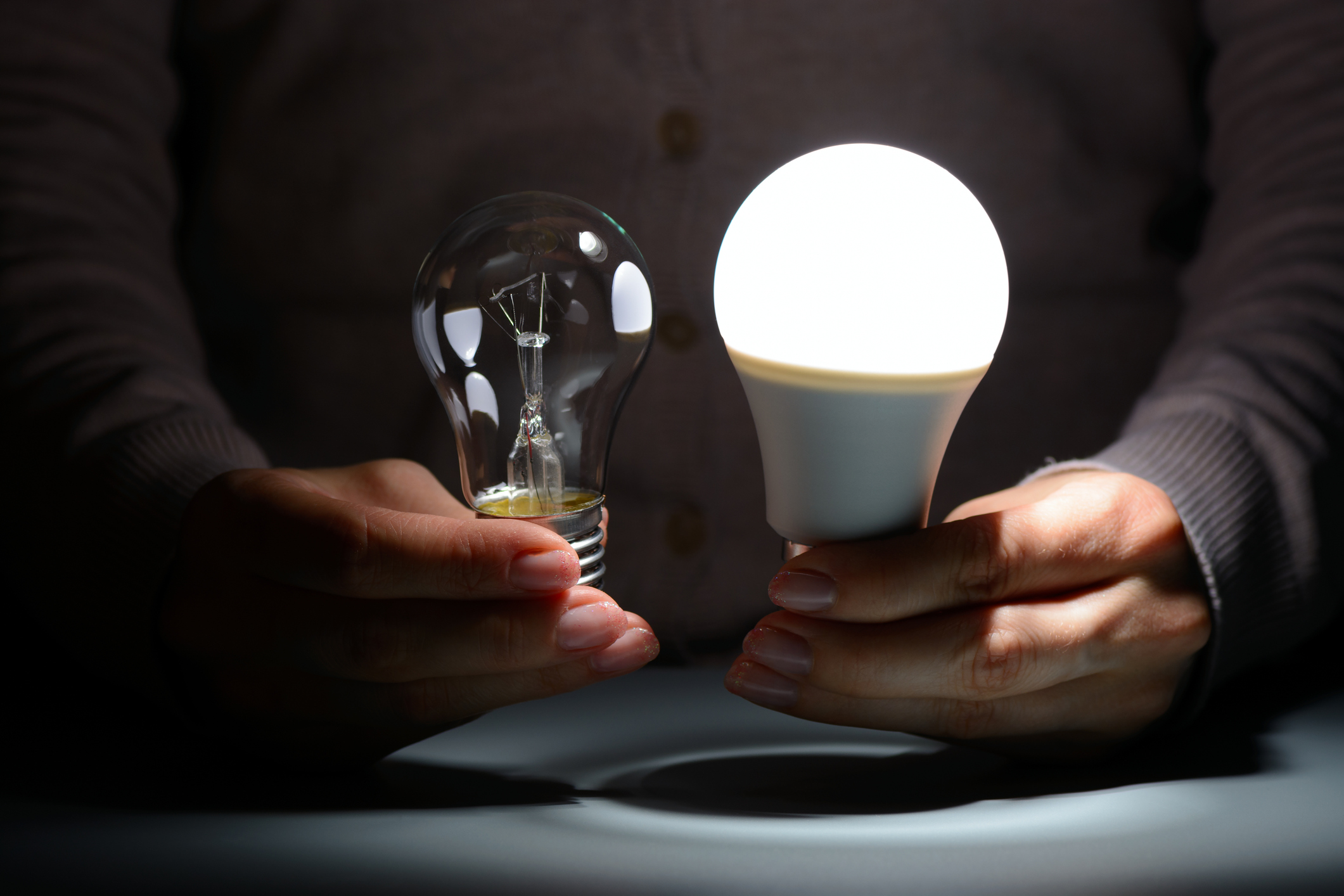
In an incandescent bulb, electricity heats a tungsten filament to around 2500 °C, and only then does it begin to emit light. The problem is that most of the energy is dissipated as heat, and only a small fraction is converted into visible light.
LEDs (Light-Emitting Diodes) work in a completely different way. Instead of heating a material, they use a semiconductor in which electrons release energy directly in the form of photons – the particles that make up light. This phenomenon is called electroluminescence and allows a much higher percentage of the electricity to be converted into useful light.
It is this difference in how they work that explains why an LED requires far less electricity to produce the same amount of light as an incandescent bulb.
Where does chemistry come in?
The word ‘semiconductor’ is usually associated with electronics, but its effectiveness depends, first and foremost, on chemistry.
Unlike a metal, where electrons move freely, or an insulator, where they can barely move at all, a semiconductor can be designed to allow only the desired movement. To achieve this, scientists carefully select the chemical elements that will make up the semiconductor material and control the way its atoms are arranged in a crystalline structure. It is this organisation, at the atomic scale, that determines how the electrons move and, consequently, the efficiency with which the LED produces light.
One semiconductor material that revolutionised this field was gallium nitride (GaN). Thanks to its electronic properties, this compound – consisting of gallium and nitrogen – enables electricity to be converted into blue light with high efficiency, forming the basis of modern LEDs.
This discovery was a true scientific milestone. For a long time, red and green LEDs had existed, but a sufficiently efficient blue LED was lacking. Once this challenge had been overcome, it became possible to develop LED lighting as we know it today – an advance that earned Isamu Akasaki, Hiroshi Amano and Shuji Nakamura the 2014 Nobel Prize in Physics.
However, the chemical composition of a semiconductor is not finalised once the crystal has formed. One of the most important steps is doping, a process in which very small quantities of other chemical elements are introduced into the crystalline structure. These additional atoms allow the movement of electrons and the locations where they release energy to be controlled – it is this controlled release of energy in the form of light that makes LEDs so efficient.

From blue light to white light
When we switch on an LED lamp, we see white light. However, this is not the colour initially produced by the semiconductor. In most cases, the crystal emits blue light. To produce white light, this blue light passes through a layer of luminescent materials, known as phosphors, which absorb part of its energy and re-emit it at other wavelengths – that is, in other colours. The combination of these colours with the remaining blue light is interpreted by the human eye as white light.
Chemistry once again plays a decisive role in the choice of phosphors. Their composition influences characteristics such as the colour temperature of the light (warmer or cooler), the accuracy with which colours are reproduced, and the energy efficiency of the bulb.
Greater efficiency, less waste
When we talk about energy efficiency, we often think only of electricity consumption whilst the light is in use. But in the case of LEDs, the savings begin long before the switch is flicked.
Chemistry also plays an important role in increasing the durability of materials, making them more resistant to heat, humidity and ageing. As a result, an LED bulb can operate for tens of thousands of hours before needing replacement. This means fewer raw materials are consumed, less energy is used in the manufacture of new bulbs and less waste is produced at the end of their useful life.
During use, to produce the same luminous flux, an LED consumes only a fraction of the electricity required by an incandescent bulb. Furthermore, as it generates much less heat, it wastes less energy.
According to the International Energy Agency (IEA), lighting continues to account for a significant proportion of global electricity consumption. Therefore, whenever a technology manages to produce the same amount of light using less energy, it also reduces the amount of electricity that needs to be generated.
If that electricity is produced from fossil fuels, the reduction in consumption translates directly into lower carbon dioxide emissions. But even in electricity systems with a high proportion of renewable energy, using less energy still means making more efficient use of available resources.
For this reason, replacing conventional lighting with LEDs is considered one of the simplest and most effective measures for reducing CO₂ emissions and improving the energy efficiency of buildings, cities and infrastructure.
The efficiency of LEDs is not the result of a single technological breakthrough, but of the combination of decades of research in chemistry and materials science. Today, every time we switch on a light bulb, we benefit from this knowledge: more light, less energy and an important step towards a more sustainable future.